

Walter De Maria Mile Long Drawing
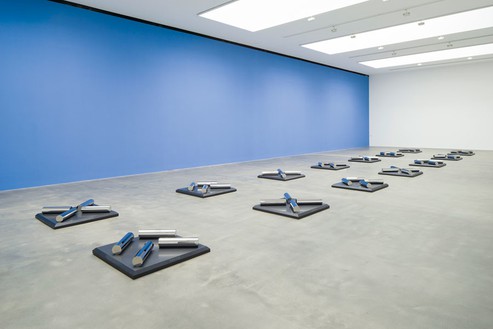
Walter De Maria, TRUTH / BEAUTY, 1990–2016
Solid stainless steel and granite, Fourteen sculptures in seven sets, each sculpture: 7 ½ × 42 ⅛ × 42 ⅛ inches (19 × 107 × 107 cm)
© 2016 Estate of Walter De Maria, photo by Joseph Asghar
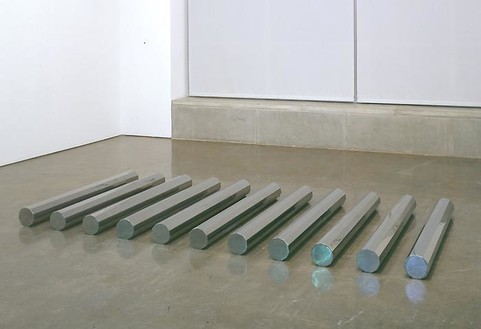
Walter De Maria, Large Rod Series: Circle/Rectangle 11, 1986
Eleven 11-sided stainless steel rods, Each rod: 5 1/16 inches diameter (12.9 cm), 52 inches long (132.1 cm)
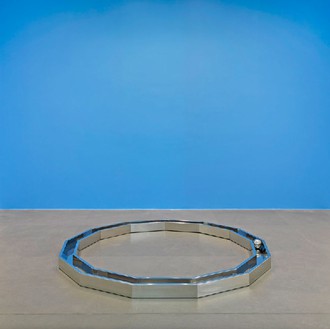
Walter De Maria, 13 Sided Open Polygon, 1984
Solid stainless steel, 4 × 83 × 83 inches; ball: 3 ¾ inches diameter (10.2 × 210.8 × 210.8 cm; 9.5 cm diameter)
Photo by Matteo Piazza
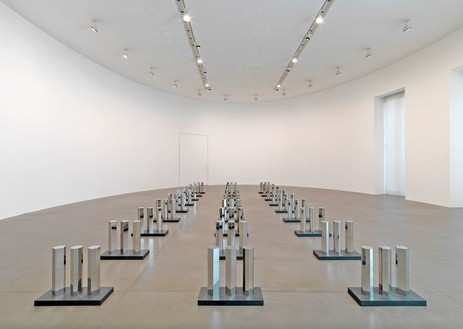
Walter De Maria, 5-7-9 Series, 1992/96
Stainless steel on granite, 27 parts each: 21 ⅝ × 12 × 26 ¾ inches (55 × 30.5 × 68 cm)
© Walter De Maria, photo by Matteo Piazza
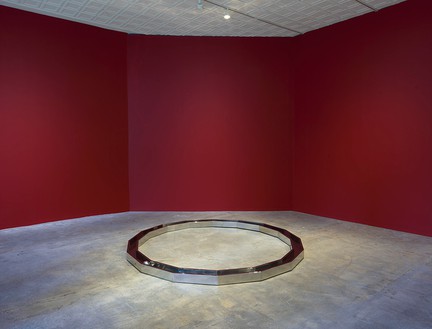
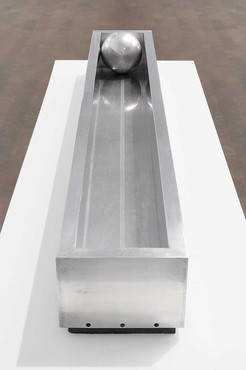
Walter De Maria, 16-Sided Open Polygon, 1984
Solid stainless steel with solid stainless steel ball, 4 × 98 ½ × 98 ½ inches (10.2 × 250.2 × 250.2 cm)
© 2017 Estate of Walter De Maria, photo by Robert McKeever
About
Any good work of art should have at least ten meanings.
—Walter De Maria
In his sculptures, land works, and installations, Walter De Maria (1935–2013) explored the relationship between the relative and the absolute, using basic geometric components to produce sublime repetitions. By arranging forms according to mathematical sequences, he worked at the intersections of Minimalism, conceptual art, and land art—drawing attention to the limits of gallery spaces, prioritizing bodily awareness, and locating the content of an artwork in the viewer.
In 1960, after completing his master's degree at the University of California, Berkeley, De Maria moved to New York City; two years later, he showed his work at a gallery he cofounded with Robert Whitman at 9 Great Jones Street. Influenced by his peers, including Donald Judd and Fluxus member La Monte Young, he produced serialized and numbered sculptural sets of cast and polished steel.
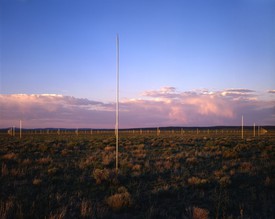
De Maria's precise polygonal structures impart a sense of the absolute. 14-Sided Open Polygon (1984), a stainless steel tetradecagon containing a steel ball, is emblematic of this distillation. The Pure Polygon Series (1975–76) is a suite of seven pencil drawings of basic geometric outlines in which a single side is added sequentially to change each shape, beginning with a triangle and ending with a heptagon. In 1977 The Lightning Fieldwas installed in a remote area of the desert in western New Mexico. Theworkcomprises four hundred polished stainless steel poles installed in a grid measuring one mile by one kilometer; the poles, meant to attract lightning, measure over twenty feet tall and have solid pointed tips that define a horizontal plane. The visitor both walks within the grid and views it from afar, observing it over an extended period of time and through space. Other major installations include The Broken Kilometer(1979), five hundred identical brass rods arranged in five rows, which, if placed end to end, would measure one kilometer; The New York Earth Room(1977), a white-walled SoHo loft filled with 280,000 pounds of soil; and The Vertical Earth Kilometer (1977), a one-kilometer-tall brass rod that stretches toward the sky from Friedrichsplatz Park in Kassel, Germany.
Truth / Beauty (1990–2016), a series of fourteen sculptures in seven pairs, was installed at Gagosian on Britannia Street in London in 2016, then at Gagosian in Le Bourget in 2016–17. At Le Bourget, the works were visible from the gallery's mezzanine passerelle, recalling the 1981–82 installation of De Maria's 360° I Ching / 64 Sculptures at Centre Georges Pompidou in Paris, where the rods were arranged within a sunken area of the museum's lobby floor.
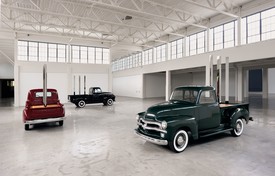
In 2017 the Walter De Maria Estate and Gagosian collaborated to posthumously complete the artist's final work, Truck Trilogy (2011–17), comprising three 1950s Chevrolet pickup trucks, each stripped of all extraneous elements and fitted with three vertical stainless steel rods in its bed: one circular in section, one square, and one triangular. Truck Trilogy was installed at Dia:Beacon in 2017 for two years.
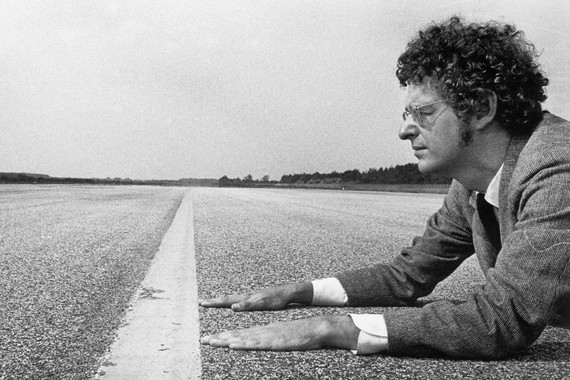
Photo: bpk Bildagentur/Angelika Platen/Art Resource, New York
#WalterDeMaria
From the Quarterly
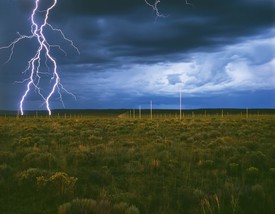
Light and Lightning: Wonder-Reactions at Walter De Maria's The Lightning Field
In this second installment of a two-part essay, John Elderfield resumes his investigation of Walter De Maria's The Lightning Field (1977), focusing this time on how the hope to see lightning there has led to the work's association with the Romantic conception of the sublime.
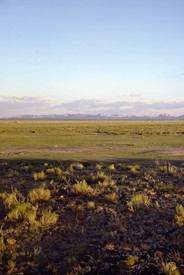
A Day in the Life of The Lightning Field
In the first of a two-part feature, John Elderfield recounts his experiences at The Lightning Field (1977), Walter De Maria's legendary installation in New Mexico. Elderfield considers how this work requires our constantly finding and losing a sense of symmetry and order in shifting perceptions of space, scale, and distance, as the light changes throughout the day.
Now available
Gagosian Quarterly Spring 2021
The Spring 2021 issue of Gagosian Quarterly is now available, featuring Gerhard Richter's Helen (1963) on its cover.
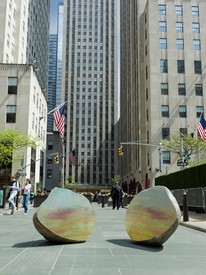
Frieze Sculpture New York: An Interview with Brett Littman
The inaugural presentation of Frieze Sculpture New York at Rockefeller Center opened on April 25, 2019. Before the opening, Brett Littman, the director of the Isamu Noguchi Foundation and Garden Museum and the curator of this exhibition, told Wyatt Allgeier about his vision for the project and detailed the artworks included.
Spotlight
Walter De Maria: Truck Trilogy
Lars Nittve investigates Truck Trilogy, Walter De Maria's last work, conceived in 2011 and premiered at Dia:Beacon in 2017.
Walter De Maria: Meaningful Work
Artist Terry Winters, longtime friend of De Maria and member of the installation crew for The Lightning Field, recounts a trip to New Mexico and the surrounding area and attests to the power—the "rhythm and pulse of ancient mystery"—that continues to imbue De Maria's artworks into the present day.
Fairs, Events & Announcements
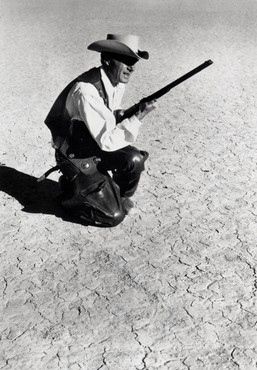
Monday, September 20, 2021, 6:45pm, and Saturday, September 25, 2021, 4:45pm
Anthology Film Archives, New York
anthologyfilmarchives.org
Walter De Maria's film HARD CORE (1969) will be screened as part of Karl Precoda Selects, a program to celebrate the publication of Alan Licht's book of interviews, Common Tones: Selected Interviews with Artists and Musicians 1995–2020 . The selected films are directed by or feature artists highlighted in the book, or are discussed by Licht and his interlocutors in the interviews. Musician, filmmaker, and scholar Karl Precoda, one of the interviewees, has selected De Maria's film, which was shot in the Black Rock desert of northwestern Nevada in the summer of 1969 and which features two pieces of music— Cricket Music (1964) and Ocean Music (1968)—composed, performed, and recorded by the artist. To attend the event,purchase tickets at ticketing.uswest.veezi.com.
Production still for Walter De Maria, HARD CORE, 1969 © 2021 Estate of Walter De Maria
April 25–June 28, 2019
Rockefeller Center, New York
www.frieze.com
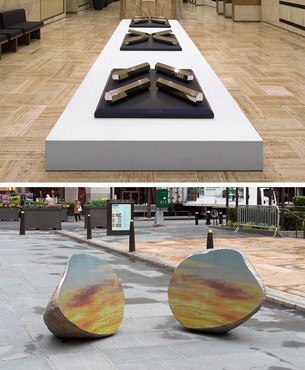
Frieze, in partnership with Tishman Speyer, is launching Frieze Sculpture at Rockefeller Center, New York, to be held annually in conjunction with Frieze New York. Brett Littman, director of the Isamu Noguchi Foundation and Garden Museum in Long Island City, New York, is curating the immersive presentation, including works by Walter De Maria and Sarah Sze.
Three of the fourteen sculptures from De Maria's Truth / Beauty series (1990–2016), which expands upon the artist's use of permutations of rods, polygons, and numerical sequences, will be shown indoors.
Sze's Split Stone (7:34) (2018), a natural granite boulder divided like a geode into two halves, in each of which the artist has embedded the image of a generic sunset, captured on her iPhone, will be outdoors.
Top: Walter De Maria, Truth / Beauty, 1990–2016 (detail) © Estate of Walter De Maria. Bottom: Sarah Sze, Split Stone (7:34), 2018 © Sarah Sze
Tuesday, December 12, 2017, 6:30pm
Dia:Chelsea, New York
www.diaart.org
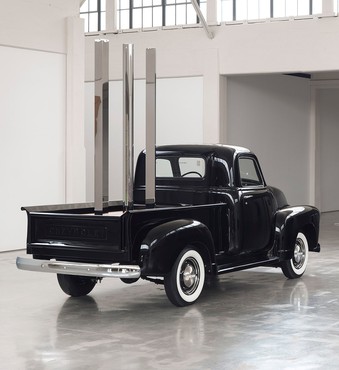
Artist Lucy Raven and musician Deantoni Parks will discuss the work of Walter De Maria. To attend this event, purchase tickets at www.diaart.org.
Walter De Maria, Truck Trilogy: Black Truck / Triangle, Circle, Square(2011–17) © 2017 Estate of Walter De Maria
See all News for Walter De Maria
Museum Exhibitions
On View
Walter De Maria
The 2000 Sculpture
Through February 20, 2022
Kunsthaus Zürich
www.kunsthaus.ch
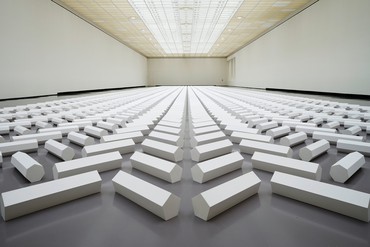
Walter De Maria's The 2000 Sculpture (1992) comprises a total of two thousand white plaster rods each 50 centimeters long and varying between 11.8 and 12 centimeters tall. The individual elements have five, seven, or nine sides. Following a specific rhythm, they are arranged on a surface covering 500 square meters, in a total of twenty rows each with one hundred rods. The result is a kind of herringbone pattern, with the rods seeming to move toward or away from the viewer, depending on where he or she stands. This creates a tension between predictable regularity and individual perception that is underscored by the light and space surrounding the arrangement.
Walter De Maria, The 2000 Sculpture,1992 © Estate of Walter De Maria. Photo: Franca Candrian, Kunsthaus Zürich
![Walter De Maria, Untitled [Desert Walk], c. 1961, Menil Collection, Houston © Estate of Walter De Maria. Photo: Paul Hester](https://gagosian.com/media/images/gallery/news/2021/5tCDtWpdIZ5G_370x370.jpg)
Closed
Dream Monuments
Drawing in the 1960s and 1970s
May 21–September 19, 2021
Menil Collection, Houston
www.menil.org
This exhibition presents drawings that challenge the conventional idea of the monument as a permanent, grand, or commemorative form. The provisional character of drawing helped artists envision forms in improbable scales and for impossible conditions, radically transforming the monument to reflect a new set of sensibilities. Scaled to the size of the page but enormous in ambition, these works rethink history while rendering environments as at turns absurd, surreal, or subjective. Work by Walter De Maria and Michael Heizer is included.
Walter De Maria, Untitled [Desert Walk], c. 1961, Menil Collection, Houston © Estate of Walter De Maria. Photo: Paul Hester
Closed
Walter De Maria in
By repetition, you start noticing details in the landscape
December 13, 2019–January 19, 2020
Le Commun–Bâtiment d'art contemporain, Geneva
mmmmm.ch
This exhibition, organized by MMMMM, explores the numerous interconnections between visual arts, minimalist composition, and 1960s experiments in the San Francisco Bay Area by looking at the intersections among nature, technology, and community. Work by Walter De Maria is included.
Walter De Maria, Instrument for La Monte Young, 1965–66 © Estate of Walter De Maria
Closed
Walter De Maria
Truck Trilogy
September 22, 2017–June 3, 2019
Dia:Beacon, New York
www.diaart.org
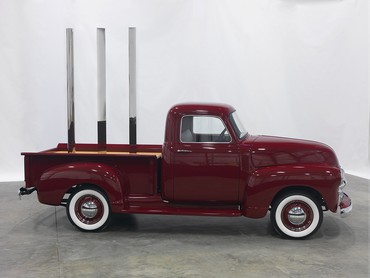
Following the completion of his Bel Air Trilogy (2000–11), Walter De Maria began his Truck Trilogy in 2011. The Truck Trilogy sculpture is composed of three 1950s Chevrolet pickup trucks. Each vehicle has been stripped of all extraneous elements, emphasizing aesthetic presence above practical function. Each flatbed has been fitted with three vertical, polished stainless steel, polygonal rods whose respective shapes are circular, square, and triangular. The sequence of rods is different in each truck. Truck Trilogy was completed posthumously in 2017 according to De Maria's original plans.
Walter De Maria, Truck Trilogy: Red Truck/Square, Triangle, Circle, 2011–17 © 2017 Estate of Walter De Maria
See all Museum Exhibitions for Walter De Maria
Gagosian Shop / Walter De Maria
Walter De Maria Mile Long Drawing
Source: https://gagosian.com/artists/walter-de-maria/
Posted by: maravillamilt1943.blogspot.com
0 Response to "Walter De Maria Mile Long Drawing"
Post a Comment