

How To Draw Male Facial Expressions
Introduction
Magdalena Proszowska, or only Magda Proski, is a pop artist well-known for her stylized, middle-communicable portraits and illustrations. She is working as a Senior Concept Creative person in the High german-based Ubisoft studio, currently fully involved in "The Settlers" game title. She joins her beloved for storytelling and world creation in expressive illustrations with lifelike characters at the center. Magdalena is a self-taught digital artist, a frequent speaker at local events, and a guest teacher at Game Fine art universities in Cologne and Dusseldorf in Germany.
Portfolio: https://world wide web.artstation.com/magdaproski
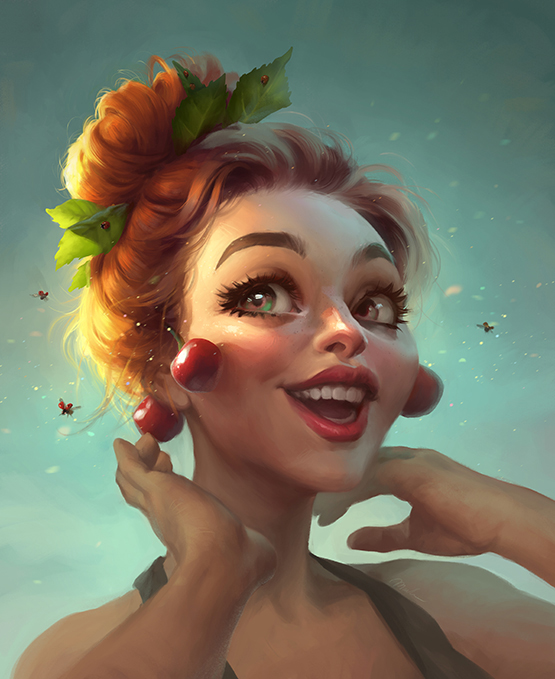
Caput construction
The face up is 1 of the nearly complex objects to pigment. It is full of bumps and cavities just like any other dimensional object, but the face besides tells stories, invokes emotions, and creates the illusion that at that place is a real person looking at the viewer from a flat ii-dimensional canvas. In the modernistic world, we are used to seeing photos of people at every corner. Imagine times where photography did not exist – what incredible experience it was to meet a painted portrait of a human being!
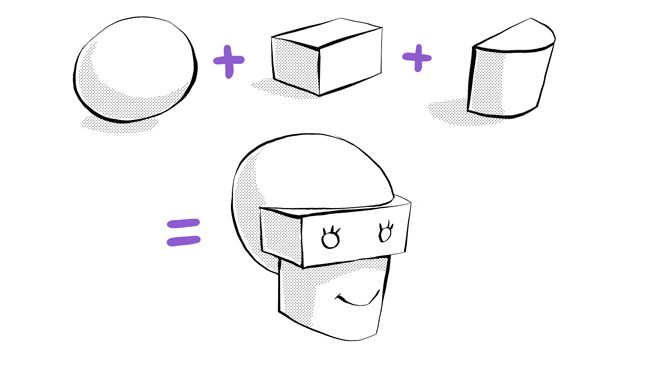
There are as many ways to construct the homo head equally there are artists out there. The head and face up are fabricated of two types of materials: the difficult and unmovable bony skull layered with soft and flexible muscle and fat. The skull tin can be simplified to just three geometric shapes: an elongated sphere, box, and half-cylinder.
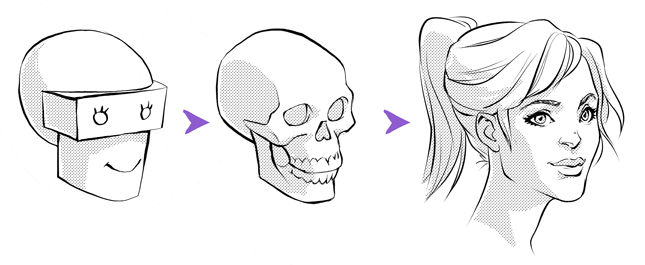
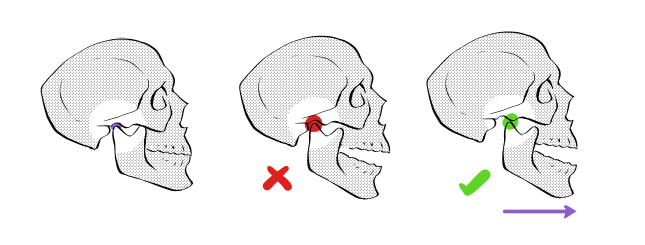
Larn the shape of the skull by heart if you want to improve your portrait skills. This part of the head is unchangeable and similar for anybody. If yous can construct a correct-looking skull, y'all tin stylize the face in any possible way and always make it look believable. The skull has just one moving part – the jaw. It has quite a flexible articulation; besides opening and closing the mouth, it can also movement to the sides and back and forth! Try to brand an underbite or grind your teeth to see what I mean.
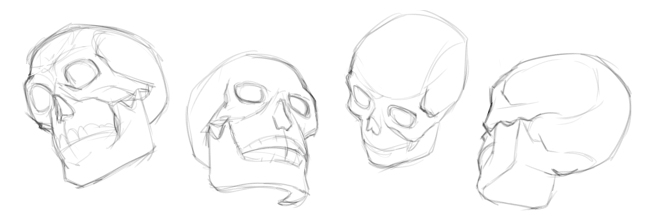
To make information technology all possible, our jaw articulation became very special. When you open your rima oris, the pivot (center of rotation) is not stationary, but your whole jaw moves slightly forrad! Identify a finger on the side of your cheek where you lot can experience the bone. Now open and shut your mouth to discover the forrad and backward movement of the jaw. At present you know why you need to move the chin forrad when drawing a person with an open oral fissure if yous want to reach a believable look.
Dimensions of the face
The skull is very important for the basic construction of the face up, but the real likeness of a person is in the shape of the soft tissues fastened to the os. As previously mentioned, the skull is covered by layers of muscles and fat. Some areas are quite thin and then you lot can easily encounter the shape of the skull beneath information technology. Other regions are quite thick and will move dramatically with different facial expressions.
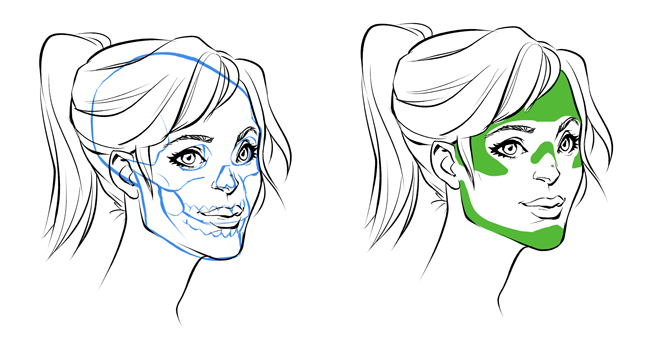
The green pattern on the face shows the areas where the skin is the thinnest and you tin can hands feel bone beneath. Those regions of the face are covered by very sparse muscles and a low amount of fat, resulting in minimal changes of shape. Places similar the cheeks, lips, and skin around the eyes can change shape a lot depending on the facial expression. It is worth noting that we can still observe surface changes on the light-green areas due to skin stretching or wrinkling.
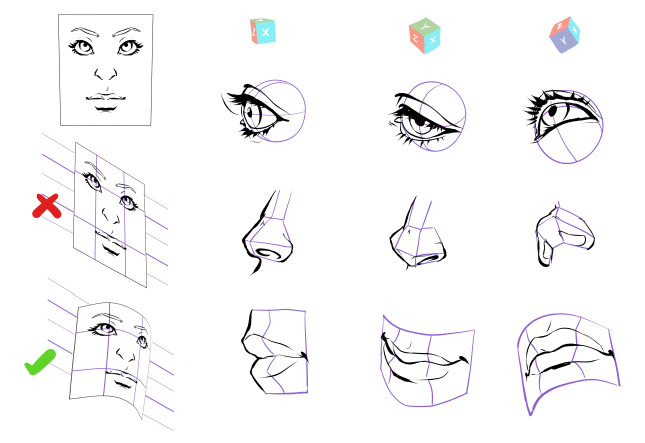
Afterward learning almost the skull, the second most important thing to remember is how spherical the shape of the face up is. The face is non a apartment plane that moves in space. It is necessary to keep in mind that all features are placed on the round surface of the head.
Face up expressions
When you smile, you practice not simply lift the corners of your lips upward. There is a cascade of musculus movement following the expression to create a existent smile on your whole face. The eyebrows, eye shape, wings of the nose, shape of the oral fissure and much more – all will move depending on the emotion that is expressed.
Find your friends and make different faces in the mirror to study carefully how dissimilar people construct emotions using their faces. You volition improve in no time and your drawn characters will become more believable than ever before!
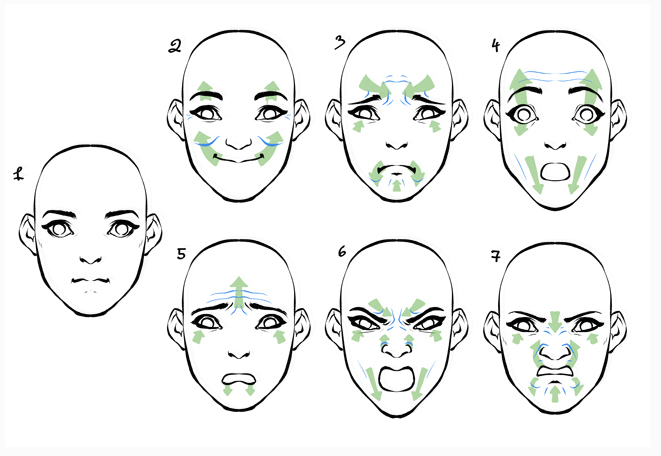
1- Neutral, two- Joy, 3- Sadness, four- Shock, 5- Fright, vi- Anger, seven-Cloy
The moving-picture show above shows simplified basic emotions with directions of musculus motion (green arrows) and creation of wrinkles (bluish lines). If you want to keep your characters looking immature exercise not suggest wrinkles with black lines, as the more wrinkles you describe in lineart on the face up, the older/uglier the graphic symbol will look. Instead, place your attention in the subtle shape of the eyes, eyebrows, and mouth as they have a huge spectrum of possible move.
Movement of the center and eyebrow
People frequently telephone call the optics "the windows to the soul." It is true, eyes are extremely an expressive feature of the face. But optics by themselves tin tell y'all if a person is smiling, scared, or angry! There are many groups of muscles surrounding the middle. The eyelids can be pulled broad to show whole the iris, or area around optics can be contracted to squint optics and create wrinkles. The eyebrows on their own have separate groups of muscles to pull the outer and inner ends – that is why eyebrows can curve up and down and create a moving ridge shape! Additional special muscles tin can pull both eyebrows together above the bridge of the nose.
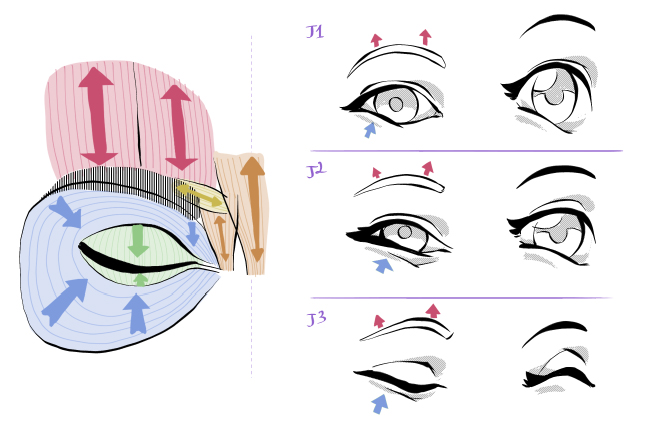
Observe the image above. Those are only a few examples of possible eye expressions associated with emotions. J1, J2, and J3 show expressions of joy. The eyebrow is neutral or slightly pulled up. Nearly importantly, the outer centre corners are squinted and elevated by the cheeks when we smiling. The squint makes a real divergence betwixt an honest or faked grinning.
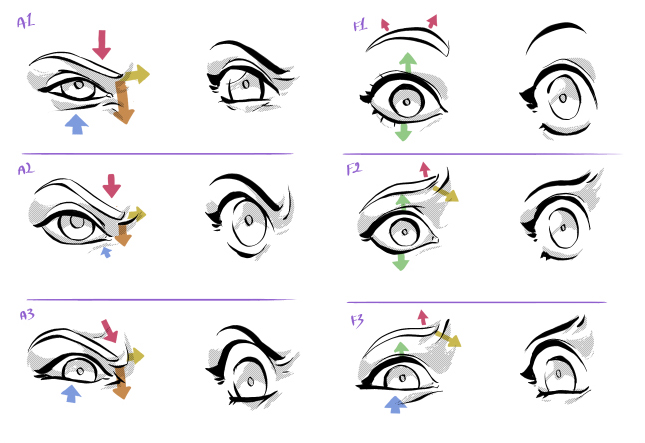
A1, A2, and A3 are expressions of anger or disgust. The muscles above the bridge of the nose practice heavy work here. They pull the eyebrows downward and together, creating many wrinkles between the eyebrows and on the bridge of the nose.
F1, F2, and F3 limited shock and fearfulness. This is the only expression when yous want to show the full iris not overlapped by eyelids. Different countenance shapes brand wide-open eyes express different emotions, from surprised to horrified.
Motility of the mouth
The lips are surrounded by multiple groups of muscles, giving them an endless adapt of shapes. This allows united states not merely to express emotions but also let u.s.a. make a variety of sounds. Beneath you lot will observe just a few examples typical for expressing joy, fear, and anger. While cartoon the oral fissure, be aware that when the teeth are separated, the chin must be lowered. The summit lip tin gyre upwards and show the teeth with a delicate curve, like in smile S2 and S3, or with a more aggressive line to limited anger and disgust (G1, G2, and G3).
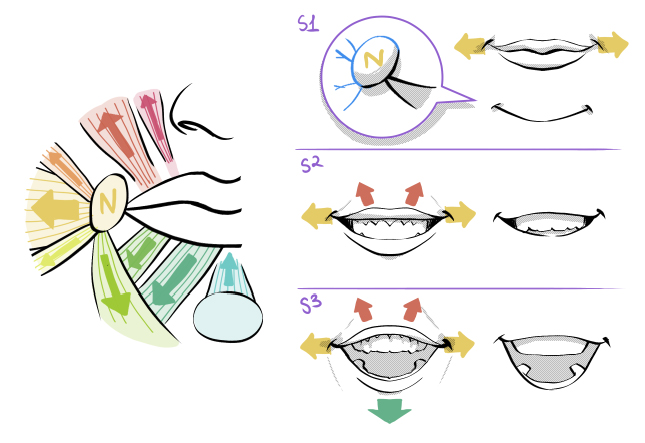
Ever wondered why the corners of the mouth are suggested with a small curved line? The corner of the rima oris includes a node (North) to which a lot of muscles are attached. See the S1 diagram. The node is a spherical shape creating a small curve (shadow) at the corner of the oral cavity.
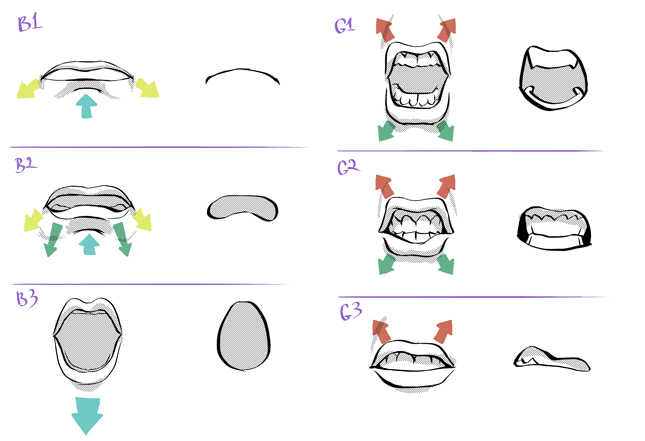
Mouth muscles tin work unsymmetrically. Yous can grinning with only one corner of your oral cavity. Discover in the mirror how many faces y'all can make!
Motion of the nose
The nose is an unappreciated feature of emotions, but when treated right, information technology can add subtle yet important expression to the face up. Find that the nostrils stretch together with the oral fissure in N4. The nostrils will open up wider when you lot inhale securely. This can create an intense look on your character like in N5. When angry or disgusted, we wrinkle our nose like in N2 and N3.
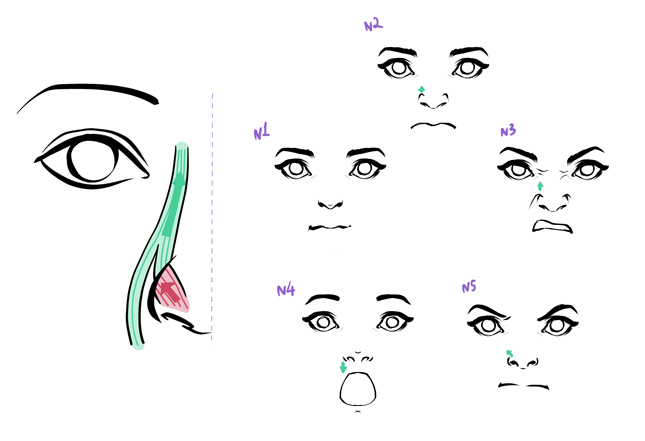
N1 – neutral, N2 – disgust, N3 – aroused disgust, N4 – shocked, N5 – intense
To conclude this introduction on drawing facial features, don't exist agape to experiment, mix together dissimilar emotions, and create unique expressions for your characters. Well-nigh chiefly, observe from nature! The mirror is an essential tool for any grapheme artist.
Creating illustrations focused on expressing emotions
Understanding the basics gives you unlimited potential for stylizing your characters. Let's get back to the beginning of this tutorial where I showed you the basic geometrical structure. Modifying the proportions of those elements allows the states to create stylized and conceivable faces.
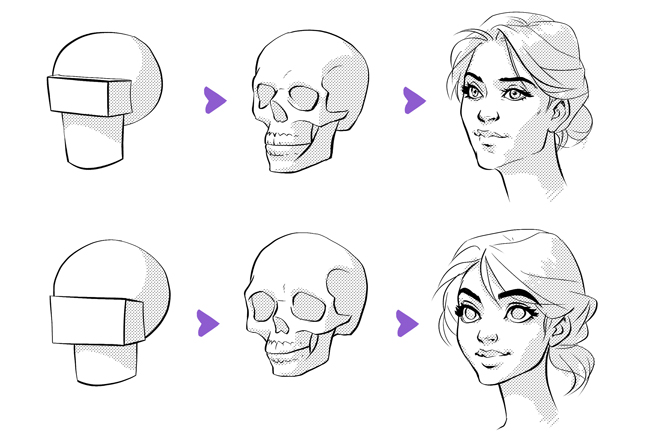
Operating with simple geometric shapes too helps yous to control the tilt of the head in perspective. I went for a cute graphic symbol with big optics and a round face up. I increased the size of the middle box and made the half-cylinder shorter. In the next step, I draw a skull fitting those proportions and a full confront on tiptop of that.
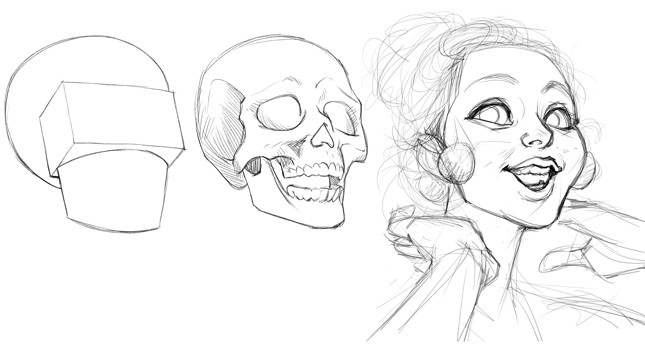
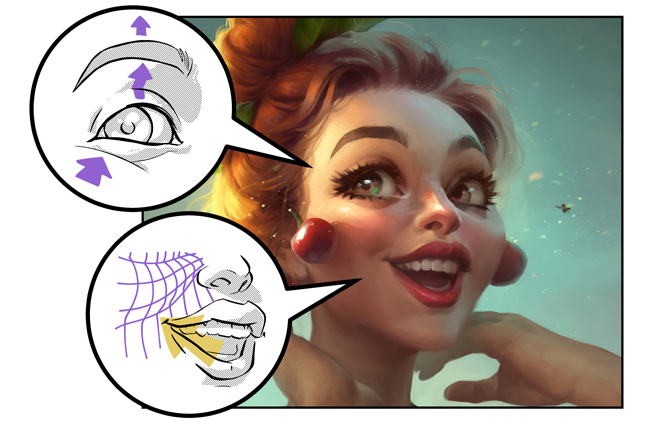
For a genuine smile, I go on in heed to enhance the eyebrows and overlap the lower chapeau with the cheek. Detect how the stretched rima oris lifts the cheek and makes the shape appear rounder.

Source: https://www.clipstudio.net/how-to-draw/archives/157239
Posted by: maravillamilt1943.blogspot.com
0 Response to "How To Draw Male Facial Expressions"
Post a Comment