

How To Draw Cn On Owl
2D Molecule Drawing Module
The 2D Molecule Cartoon Module (MDM) allows students to draw chemical structures or reactions as answers to Smartwork questions. An example of an MDM trouble is shown below. Depending on your screen resolution or your browser settings, you may demand to adjust the zoom in order to come across the entire MDM. The figure beneath shows the top portion of the MDM window, and the bottom can exist accessed past scrolling down the page.

The effigy below shows the entire MDM, which consists of a white workspace surrounded by a nighttime-grey border that contains several toolbars.

The effigy in a higher place presents the MDM with a "blank" module workspace (the white area). Students may besides see the MDM shown with a chemic cartoon prompt, such as an atom, molecule, chemical reaction, or chemical scheme. The effigy below provides an example of what the MDM may look like when a prompt is shown. Depending on the nature of the question being asked, the prompts tin can vary widely.

There are iii main toolbar areas within the MDM border. The toolbar areas are highlighted in the effigy below as follows: formatting tools (red), drawing tools (blue), and elemental symbols (green).

Hither is a video introduction to the second Molecular Cartoon Module:
2nd Molecule Drawing Module – Toolbar Introduction
Formatting Toolbar:The formatting toolbar on the top left of the MDM contains iv or v tool options depending on the country of the workspace window. A zoomed-in view of the formatting toolbar's v-tool version is shown here:

(Note: Only the four-tool selection is shown in the previous MDM views upwards in a higher place.)
The table beneath gives the proper noun and general role of each of the five tools in the formatting toolbar.
| Formatting Toolbar Push | Tool Name | Tool Function |
| | Clear | The Articulate tool is used to return the workspace window to its original land. This tool tin likewise be accessed via the hotkey: CTRL+DEL |
| | Undo | The Disengage tool erases the last modify that occurred in the workspace window. This tool can also be accessed via the hotkey: CTRL+Z |
| | Redo | The Redo tool reverses an Undo command, bringing back whatever modify had been cleared by Undo. Therefore, the Redo part is simply bachelor after the Disengage tool has been used. This tool can too be accessed via the hotkey: CTRL+Y |
| | Zoom | The Zoom tool allows you lot to zoom in or out within the workspace window. Clicking the lower-right corner of the icon opens a dropdown menu that gives iii options. |
| Zoom dropdown carte du jour | In the Zoomdropdown carte du jour, the three options from left to correct are: zoom-in, zoom-out, and zoom-all. | |
| | Make clean | The Make cleantool organizes the objects fatigued in the workspace. Results tin include ensuring that all bonds are of equal length and that bond angles are reasonable. |



Here is a video introduction of the Formatting Toolbar:
Drawing Toolbar:The cartoon toolbar on the left side of the MDM contains eight tool options. A zoomed-in view of the toolbar is shown here:

The following tabular array lists and gives the name of each tool along with a brief word of its role.
| Drawing Toolbar Button | Tool Proper noun | Tool Role |
| | Rectangle Option | The Rectangle Pick tool allows yous to select multiple atoms, bonds, etc., by clicking inside the workspace and dragging a rectangular choice surface area to your desired size. |
| | Delete | The Delete tool can exist used to erase private atoms or bonds by clicking on them. The tool can also select multiple components when dragged, similar to the Rectangle Option tool, and components that are highlighted are deleted upon releasing the mouse button. |
| | Bonds | The Bondstool allows new bonds to be added or a current bond to exist changed to a different type. Clicking the lower-right corner of the icon opens a dropdown carte that gives three options. |
| Bonds dropdown menu | In the Bonds dropdown bill of fare, the three bonding options from left to correct are: single, double, and triple. | |
| | Increment Charge | The Increase Chargetool applies a positive charge to a neutral atom. If the atom is already charged, each click volition increase the charge by 1. |
| | Decrease Charge | The Decrease Chargetool applies a negative accuse to a neutral atom. If the atom is already charged, each click volition decrease the charge by 1. |
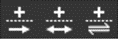
| | Reaction Arrow | The Reaction Arrowtool allows you to add an arrow to a chemical reaction past clicking and dragging in the workspace. Additionally, clicking in the workspace adds a + symbol. Clicking the lower-correct corner of the icon opens a dropdown menu that gives 3 options. |
| Reaction Pointer dropdown carte du jour | In the Reaction Arrow dropdown carte, the three options from left to correct are: straight, 2-headed, and equilibrium arrows. | |
| | Lone Pair | The Alone Pairtool applies lone electrons to an atom within the workspace. Clicking the bottom-right of the icon opens a dropdown bill of fare that gives 2 options. |
| Alone Pair dropdown carte | In the Lone Pair dropdown menu, the two options from left to right are: lone pair (two electrons) and radical (single electron). | |
| | Rectangle | The Rectangle tool allows yous to draw a rectangle inside the workspace window. |






Hither is a video introduction of the Drawing Toolbar:
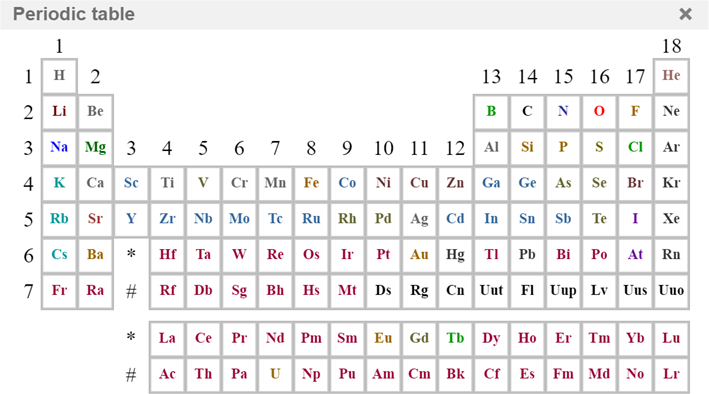
Elemental Symbol Toolbar:The Elemental Symbol toolbar on the right side of the MDM contains an choice to access any element of the periodic tabular array, as well equally x of the most commonly used elemental symbols. To add together a specific symbol to the workspace, click the element on the right and so click on an unused expanse of the workspace. If the chemical element needed is not on the listing, click the periodic table push,  , to see the entire periodic table. The figure below shows the periodic tabular array that will display when the button is clicked. Clicking on any chemical element in the displayed periodic tabular array returns you back to the workspace. The chemical element that was clicked is at present agile and can exist used as stated to a higher place.
Here is a video introduction of the Elemental Symbol Toolbar:
Using the 2nd Molecule Drawing Module
Example one: Methyl hydride, CHfour
The adjacent few figures will show you how to apply the MDM to draw some chemical figures. The first molecule is methyl hydride, CH4. Once complete, your molecule should look similar to this:
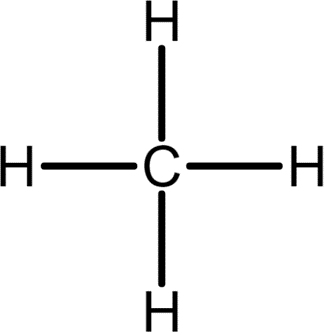
In the MDM workspace, click on the C (for carbon) icon in the Elemental Symbols toolbar. In the figure below, notation that the C has been highlighted in gray, denoting that it has been selected.

With the C at present active, click in the white workspace area. This will put the carbon atom where you clicked.

Activate the H by clicking on the H icon in the Elemental Symbols toolbar. Now, mouse over the C in the workspace. The C will become highlighted in light-green.

With the C highlighted, click and concord the left mouse push button while dragging the mouse abroad from the C atom. This will depict a single bond between the C and the H when you release the mouse button.

Using this same method, depict the remaining 3 hydrogen atoms on the carbon. Your drawing should await similar to the picture below, depending upon which directions you dragged your mouse.

For a better view, click on the Zoom button,  .
.

Note: Y'all don't need to zoom in earlier submitting your respond, but y'all may find it useful to do then to ensure that all atoms are bonded as you intended. Additionally, Smartwork will grade your reply based on connectivity (how the atoms are continued) rather than what the molecule you drew looks similar. In this instance, so long as the carbon has the 4 hydrogens attached, your answer will be marked every bit correct.
Beneath is a video demonstration of Case 1:
Example ii: Water, HiiO
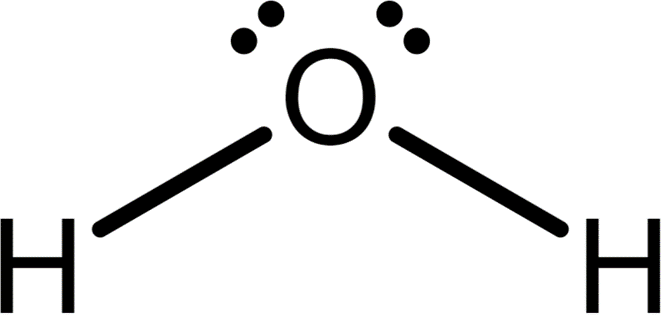
Using a method similar to that for CH4 above, yous can describe water, H2O. The h2o molecule, as shown in the figure below, has lone pairs of electrons on the oxygen cantlet. To add them, yous will need to use the Lone Pair tool,  . The final drawing should look similar to this:
You lot can start by selecting the O cantlet from the Elemental Symbols toolbar and clicking in the white workspace.

Actuate hydrogen by clicking on the H icon in the Elemental Symbols toolbar. Mousing over the O in the workspace will highlight the O green.

With the O highlighted, click and hold the left mouse button while dragging the mouse away from the O atom. This will draw a unmarried bail between the O and the H when you release the mouse button. To add the second H atom, click on the O and drag again.

To access the Alone Pair tool dropdown card, click on the Lone Pair tool icon, .

The O atom in water should accept two lone pairs of electrons. In the dropdown menu, click on the pair of electrons (ii dots) to activate information technology. To add the starting time pair, click on the O atom.

To add the 2d pair, click on the O atom again. Detect that the positions of the alone pairs on the O atom are automatically adjusted when the second pair is added.

To "clean up" the construction, click on the Clean tool,  . The Make clean tool is especially helpful when cartoon more complicated structures, every bit it organizes the cartoon(s) within the workspace. For a better view, click on the Zoom push button, .

Beneath is a video demonstration of Example ii:
Example three: Isocyanate ion, OCN–
In drawing the isocyanate ion, OCN–, you will learn how to add together charges to atoms using the Increase Charge,  , and Decrease Charge,
  , tools. Y'all will too acquire how to add the triple bond between the O and C atoms using the Bond tool,
  .
.
Annotation: While the particular resonance structure of the ion shown below is not the most chemically stable, information technology was chosen since several MDM tools could be used to draw it.

In addition to the method presented in the previous two examples, another way to depict a molecule that contains multiple chemical elements is to draw the basic construction using only i element and then using the Elemental Symbols tool bar to change them to the proper elements. In this example, the basic structure is fatigued with all C atoms.
Click on the C in the Elemental Symbols toolbar. Next, click in the white workspace. The C atom will appear. Mouse over the C atom to highlight it. Click and concord on the C while dragging the mouse to the right. A 2d C bonded to the offset will display.

Mouse over the C atom on the right to highlight it. Click and hold while dragging the mouse again to the right to make the third C announced. You structure should await like this.

To alter the left C atom to an O atom, click on the O in the Elemental Symbols toolbar, followed by clicking on the left C atom.

Repeat the process to change the C atom on the right to a N cantlet. Click on the North in the Elemental Symbols toolbar, followed by clicking on the right C cantlet.

To add the triple bond between the O and C atoms, click on the bottom right of the Bond tool, . From the dropdown menu, select the triple bond (iii lines) circled in red in the figure below.

Mousing over the bond between the O and C atoms will highlight information technology green.

Clicking on the highlighted bail volition change it to a triple bail.

To brand the molecule larger within the workspace, click to open the Zoom dropdown menu, , and select the Zoom-in tool (circled in red below).

Click on the Zoom-in button several times to increase the size of the molecule in the workspace.

To add the solitary pairs to the molecule, click the Lone Pair tool, . Mouse over the O atom to highlight it, and and then click once to add together its lone pair. Repeat this process past mousing over the N cantlet and clicking iii times, in one case for each lone pair.

According to the original molecular cartoon above, the formal accuse on the O atom is ane+, while that of the N atom is 2–. The C atom has a formal charge of zero. To add the one+ charge to the O atom, click the increase charge tool, . Highlight the O atom and click on it once. The accuse will appear on the upper right side of the O atom.
Note: After doing this, only the plus symbol (+) will be shown; the number i is omitted from the structural drawing.

To add the 2– charge to the N atom, click the Subtract Charge tool, . Highlight the N atom and click on it twice. The accuse will appear on the upper-right side of the N atom. For a improve view of the molecule, click the Zoom push button, , and select Zoom-all from the dropdown carte du jour.

Notation: When adding charges to atoms, click the number of times necessary to increment or decrease the accuse to the appropriate value. If yous click too many times, you tin can click the undo push,  , or apply CTRL+Z to go back to the appropriate accuse. Another option is to continue clicking on the cantlet to cycle back to the proper charge.
Beneath is a video demonstration of Instance three:
Drawing Errors
A warning bulletin volition be displayed if you draw two arrows on top of each other. To dismiss the bulletin, use the delete tool to remove 1 of the duplicate arrows before continuing.
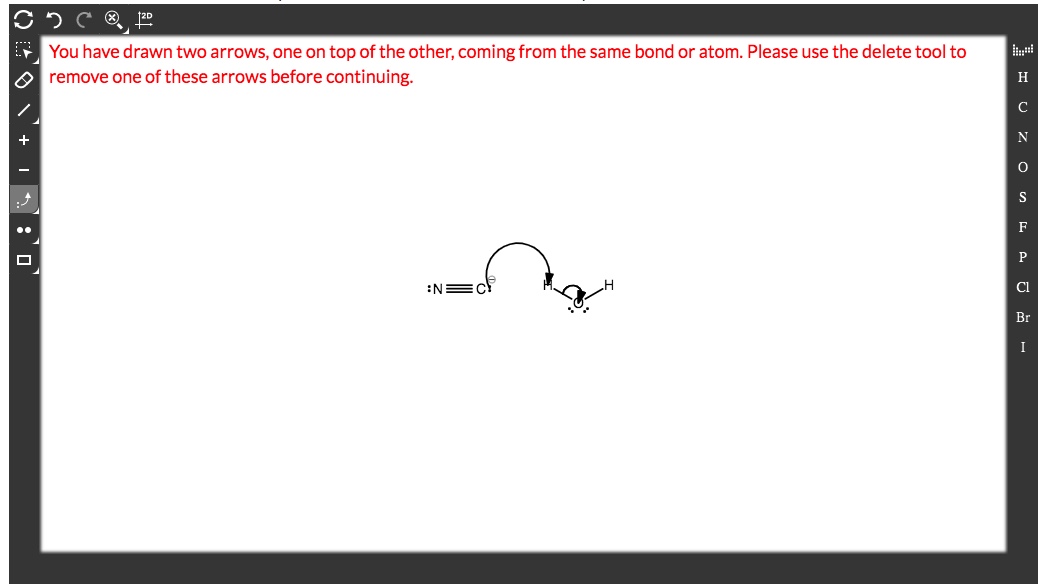 Instance of error alarm

Source: https://wwnorton.knowledgeowl.com/help/smartwork5-students-2d-molecule-drawing-module
Posted by: maravillamilt1943.blogspot.com
0 Response to "How To Draw Cn On Owl"
Post a Comment